Music Night Battle - Full Mods
- 4.5
- Rating
- 5.00M
- Installs
- Free
- Price
 Analysis by App-foxy
I approached Music Night Battle - Full Mods as a rhythm game first, but its real test is how comfortably different people can read, control, and enjoy its fast musical challenges. The basic idea is easy to understand: follow the beat, react to prompts, and compete in a Friday Night Funkin-inspired music battle. In practice, the experience asks for quick visual attention, accurate timing, and repeated finger movement, so the quality of the session depends as much on the player’s situation as on their taste in music.
The game is free to download and belongs to the music category. It comes from AMANOTES PTE. LTD., a developer with experience in mobile rhythm entertainment. A 4.6 average from around 44 thousand ratings and more than 5 million installs suggest that the format has found a sizable audience. I would still treat those figures as a sign of popularity rather than a guarantee that every player will find the controls comfortable.
What interested me most was the gap between its inviting presentation and its physical demands. Someone who enjoys short, energetic music challenges may find it immediately approachable. Someone who needs generous timing, large controls, reduced visual stimulation, or reliable play without sound may have a much harder time. That distinction matters, especially because the game carries a Mature 17+ content rating and includes optional purchases ranging from $0.99 to $54.99 per item.
You May Also Like

 Blood Strike: 2.5 Anniversary
Blood Strike’s Loadouts Turn Every Drop Into a Tactical Gamble
A close look at Blood Strike’s custom loadouts: how fast access to signature weapons reshapes its battle royale rhythm, rewards preparation, and narrows the gap between fights.

 Pandora - Music & Podcasts
Pandora’s Music Is Easy to Start, but Harder to Recover
Pandora’s strength is its low-effort path from a seed to a station. Its weak spot is how much confidence it asks you to place in connection, setup, and quiet recovery.

 8 Ball Pool
 Is Built on Rivalries, Rematches, and Routine
A close look at the rivalries, rematches, shared routines, and unanswered safety questions that turn a quick pool match into a persistent mobile community.

 Samsung Music
’s Quiet Strength Is Playing What You Already Own
Its reach comes less from spectacle than from dependable access to a personal library. That simplicity is both the app’s strongest retention engine and its ceiling.

 AccuWeather: Weather Radar
AccuWeather Review: A Quick, Clear Forecast for Everyday Decisions
For everyday plans, the best forecast is the one you can understand quickly. AccuWeather makes rain timing, radar, and local conditions easy to act on, with a few trade-offs.

 Hill Climb Racing
Why Hill Climb Racing Still Turns Crashes Into One More Run
A tiny car, a bumpy hill and one more upgrade: Hill Climb Racing keeps resurfacing because its simple chaos makes every near-miss feel personal.
More From Our News Desk



How clearly the game communicates what is happening
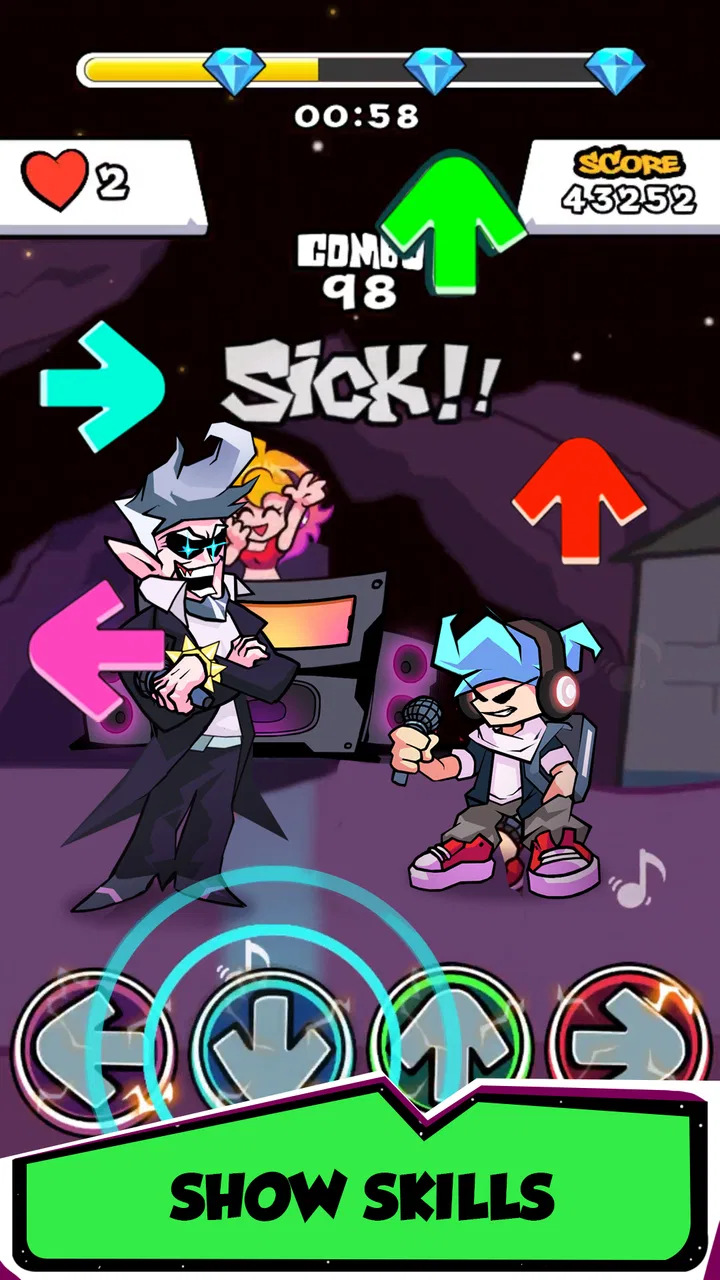
The strongest part of the experience is the simple relationship between music and action. You do not need to learn a complicated menu system before understanding the central task. The screen presents a musical confrontation, and your attention naturally moves toward the notes or prompts that determine your next action. That direct structure is useful for first-time players because it turns the game into something you can understand by watching one round.
For me, the visual language works best when I concentrate on one area of the screen instead of trying to follow every animation. Rhythm games often tempt you to watch the characters, background effects, score feedback, and incoming prompts at the same time. That is a poor strategy here. I get better results by treating the decorative action as background and keeping my eyes on the lane or indicator that tells me when to respond. This is a small but important adjustment for anyone who finds busy screens tiring.
The “Full Mods” identity also sets an expectation of variety. The appeal is not simply tapping through one repeated song; it is the feeling of entering different musical battles and adapting to their patterns. That variety can keep the game fresh, but it may also make the learning curve feel uneven. A player who has just become comfortable with one rhythm pattern may encounter another that demands a different pace or more precise reactions.
I would not describe the navigation as something that requires technical knowledge. The bigger issue is attention. A player with limited vision, reading difficulty, or sensitivity to rapidly changing backgrounds may need to focus carefully on whether the important prompts remain distinguishable from the surrounding action. I found that playing in a quiet environment and holding the phone at a comfortable distance made the information easier to process than trying to play while walking, commuting, or watching television.
There is also a practical difference between understanding a prompt and reacting to it quickly enough. The game can be clear in principle while still being demanding in execution. That is common in rhythm titles, but it is worth saying plainly: readable does not automatically mean easy. If your main reason for downloading is relaxation, this may not feel as forgiving as a slower music toy or a casual tap game.
Reading the action without chasing every effect
My most useful habit was to establish a visual anchor before attempting to improve my score. I watched where the actionable cues appeared, ignored the character reactions during difficult passages, and used the musical pulse as a second source of information. This approach is especially helpful for players who become overwhelmed when several moving elements compete for attention.
It also gives a clearer answer to a common question: can a newcomer play without knowing Friday Night Funkin beforehand? Yes, the basic rhythm concept is approachable without prior knowledge. Familiarity with that style may help you understand the mood and structure more quickly, but it is not necessary to recognize the original culture around it before starting. The challenge comes from timing, not from having to understand a complicated story or rulebook.
On the other hand, I would not choose this game for a player who depends on very large text, highly simplified screens, or extensive navigation customization. I found the core action easier to understand than the overall sensory presentation. That is an important distinction for families deciding whether the game is suitable for someone who needs a calm, low-distraction interface.
Motor demands, sound, and sensory comfort
The main physical barrier is timing. Music Night Battle asks you to coordinate what you see with what you hear and then make a quick touch response. That combination is enjoyable when your hands and attention are ready, but it can be frustrating for anyone with tremors, limited dexterity, slower reaction time, hand fatigue, or difficulty maintaining a steady rhythm.
I recommend playing with the phone supported rather than holding it loosely in one hand. A stable position reduces accidental movement and lets the tapping hand work with less strain. It also makes short practice sessions more manageable. I would rather play several brief rounds than continue after my fingers become tense, because fatigue quickly turns a timing challenge into a test of endurance.
Players who use one hand should think about device size and grip before committing to longer sessions. The game is designed around active touch input, so reaching across a large screen or shifting the phone during a difficult sequence can cost accuracy. A smaller device may be easier to control physically, while a larger display may make visual cues easier to see. That is a genuine trade-off rather than a universal advantage for one type of phone.
Sound is another major part of the experience. The music provides more than atmosphere; it helps establish the rhythm that guides your responses. Playing with audio muted or in a noisy room removes one of the most useful timing references. A player who cannot rely on sound may still understand the visual prompts, but the task becomes more visually demanding because every beat has to be read rather than anticipated through the music.
For sensory-sensitive players, the combination of music, character movement, changing backgrounds, and rapid feedback deserves attention. I would start with a short session at a moderate volume and stop if the screen feels tiring rather than assuming the discomfort will disappear. Earphones can make the beat easier to isolate from surrounding noise, but they can also make the audio feel more intense. The better choice depends on whether outside sound or concentrated sound is the bigger problem in your environment.
The Mature 17+ rating is also relevant to suitability. I would not present this as a general-audience music game for young children simply because the controls look familiar. Parents and older players should review the game’s tone and presentation for themselves, particularly if the device is shared. The rating is part of the decision, not an incidental label.
Small habits that make demanding rounds more manageable
I found three practical adjustments more valuable than chasing perfect reactions immediately. First, I played while seated, with both the screen and my wrists supported. Second, I learned to identify the beat before trying to maximize accuracy. Third, I treated missed notes as information about timing instead of repeatedly restarting in frustration. These habits do not change the game’s difficulty, but they reduce avoidable physical and mental strain.
Another useful trade-off is choosing progress over performance. If you are playing after work, during a break, or while tired, a demanding song may be entertaining for a few minutes but unpleasant as a long session. The game is better suited to focused bursts than to background play. It asks for active concentration, so it competes badly with conversations, television, or any task that requires looking away from the phone.
This is where it differs from many conventional music apps. A streaming service lets you listen passively, and a simple piano or beat-making app may let you experiment at your own pace. This game turns music into a reaction test. That is its strength for players who want challenge, but its weakness for anyone looking for creative control, calm listening, or a flexible tempo.
Using it in real situations
My most realistic use case is a short session at home when I want something more active than scrolling but less involved than a full console game. I can play a few battles, put the phone down, and return later without needing a long setup. That makes the format convenient for a break, provided I have enough quiet and attention to follow the beat.
I would be more cautious about playing on public transport or in a crowded waiting room. Movement, glare, announcements, and people nearby can all interfere with a timing game. The screen may be readable in an ordinary room but much less comfortable outdoors or under harsh lighting. Since accuracy depends on quick visual decisions, a poor environment affects the experience more than it would affect a turn-based puzzle.
It can also work as a shared discovery game among friends who enjoy comparing reactions and musical preferences. The competitive mood gives people something to discuss after a round, even when nobody is trying to play perfectly. Still, I would not assume that everyone in a group can participate equally. A friend with slower motor responses may enjoy the music and style but dislike being measured against someone who has stronger rhythm-game experience.
For players who are deaf or hard of hearing, the visual side may offer a starting point, but I would not call the experience equally accessible without relying on audio. The prompts are visible, yet the music is central to the timing relationship. A player who cannot use the soundtrack may need to depend on visual anticipation and may find the challenge less intuitive. That is not a reason to dismiss the game, but it is a reason to approach it with realistic expectations.
For players with attention differences, the quick rounds can be appealing because they provide immediate goals and frequent feedback. At the same time, the constant motion and musical intensity may become distracting rather than motivating. I would try the game in a controlled setting, with notifications silenced and a clear stopping point. The ability to enjoy the game may depend less on skill than on whether the surrounding environment lets you focus.
People who want to play offline during travel should also think about their expectations. I would not build a travel plan around assuming every part of the experience will behave identically without a connection. Instead, I would test the game before leaving and avoid depending on it as the only entertainment for a long journey. That is a sensible precaution for any mobile title with optional purchases and regularly changing content, without claiming a specific connection policy.
Where the experience still creates friction
The biggest limitation is that the game’s central appeal is also its narrowest requirement: you need to respond quickly and consistently. There is no way to make a demanding rhythm battle feel like a passive music player. If your hands hurt easily, your reactions are affected by medication or fatigue, or you simply dislike being judged by timing, the format may become stressful.
I also see a potential accessibility gap between visual clarity and visual comfort. A player may be able to identify the prompts but still struggle with motion, contrast, screen glare, or competing animations. Without assuming controls or display options that are not established here, my advice is to test a short session rather than deciding from screenshots. The actual question is whether your eyes can stay focused on the actionable information for several minutes.
In-app purchases are another point to approach carefully. The game is free, which lowers the barrier to trying it, but individual purchases can reach $54.99. I would set a spending boundary before handing the phone to a child or letting someone else use the account. Free entry is useful, yet it should not be confused with an entirely cost-free long-term experience.
The current version is 1.5.0, and the game requires at least iOS or Android 10. That makes the operating-system requirement important for anyone using an older phone or tablet. A device that technically launches the game may still provide a less comfortable experience if it has a small display, aging touch response, weak speakers, or limited battery life. For rhythm games, those everyday hardware details can matter more than they do in a slow puzzle.
I would skip it if you want a quiet, highly adjustable music experience; if you need extensive assistance for timing or touch control; or if you are choosing entertainment for someone below the Mature 17+ age guidance. I would also choose another option if your priority is composing music, listening without interaction, or playing comfortably in noisy and visually unstable places.
By contrast, I think it is a good match for someone who enjoys the Friday Night Funkin style, wants quick musical challenges, and likes improving through repetition. It is particularly appealing when you have a few uninterrupted minutes and want an activity that rewards concentration. The game’s popularity makes sense to me because the premise is immediately active: you are not just hearing a track, you are trying to stay inside it.
My inclusive verdict after weighing the trade-offs
Music Night Battle - Full Mods succeeds as an energetic mobile rhythm game with an easy-to-grasp premise and a strong reason to replay difficult musical sections. I enjoyed the direct connection between the soundtrack and the touch response, and I think the free entry makes it reasonable to test before deciding whether the style suits you. AMANOTES PTE. LTD. has shaped it for players who want quick battles rather than a passive listening experience.
Its inclusive qualities are more limited than its welcoming presentation. The game can be understandable for newcomers, but understanding the action is only the first step. Fast timing, active touch control, visual movement, and reliance on musical cues create barriers for players with motor, sensory, attention, or situational needs. Those barriers do not make the game unusable, but they do make personal testing essential.
My recommendation is to begin with a short, supported session in a quiet place. Keep the phone stable, focus on the actionable prompts, and judge comfort before worrying about scores. If the music helps you anticipate the rhythm and the visual activity remains manageable, the game can become a satisfying pick-up-and-play challenge. If you need slow pacing, strong customization, or low sensory demand, a different music app or gentler rhythm game will probably serve you better.
In the end, I see this as a focused recommendation rather than a universal one. For rhythm-game fans, the combination of musical battles and quick repetition is appealing. For players evaluating accessibility, the right question is not whether the game looks simple, but whether its timing demands fit your hands, eyes, ears, and surroundings. Try it with those conditions in mind, and its 4.6 average and broad audience become useful context rather than the only reason to install it.
FAQs for Music Night Battle - Full Mods
01What is Music Night Battle - Full Mods?
Music Night Battle - Full Mods is a rhythm-based music game inspired by the popular Friday Night Funkin’ style. Players follow on-screen notes and tap, hold, or swipe in time with different songs while facing musical opponents. The “Full Mods” name suggests access to a broad selection of themed battles and custom content, although the exact songs, characters, and features may vary depending on the version installed.
02How do you play Music Night Battle - Full Mods?
Gameplay is based on timing and rhythm. Notes move toward a target area, and you must press the corresponding controls when they align correctly. Accurate inputs build your score and help you win the musical battle, while missed notes reduce performance. Beginners may need a few attempts to learn the speed and patterns, especially on harder tracks, but the controls are generally simple to understand.
03Does Music Night Battle - Full Mods work offline?
The core gameplay may be available without a continuous internet connection, which is useful when playing during travel or in areas with limited coverage. However, some versions may require internet access for the initial download, advertisements, updates, extra content, or verification. Because availability can differ between releases, it is best to launch the game once while connected and check which modes remain accessible offline.
04Is Music Night Battle - Full Mods safe to download?
Safety depends heavily on where the application is obtained. The safest option is an official app store or a trusted publisher page, where permissions, reviews, and update information can be checked. Avoid modified APK files from unknown websites, since they may contain unwanted software, excessive advertising, or altered content. Before installing, review requested permissions and use mobile security tools when available.
05Are there in-app purchases or advertisements in Music Night Battle - Full Mods?
Many free rhythm games use advertising to support development, and Music Night Battle - Full Mods may display ads between songs, menus, or attempts. Some releases can also include optional purchases or modified features, but the exact monetization system depends on the version and platform. Check the store listing before downloading, and remember that unofficial “full mod” versions may not follow the same purchase or privacy policies as official releases.
Pros
- Quick matches make it easy to play in short sessions.
- Multiple mod options add variety beyond the standard battles.
- Simple touch controls are easy for new players to understand.
- Music-focused gameplay gives each round a lively atmosphere.
- Runs well on many older devices with modest hardware.
Cons
- Some mods may feel unbalanced compared with the original gameplay.
- Repeated songs can make the experience feel repetitive over time.
- Ads may interrupt the flow between battles or menu screens.
- The interface can be confusing when switching between mod packs.
- Unofficial content may vary in quality and receive limited updates.

Music Night Battle - Full Mods
Gallery